Insight · Broker-dealers, Investment advisers
Supervising Generative AI Under FINRA Rule 3110
FINRA has no AI rule; it has Rule 3110. What Notice 24-09 expects, and the records, reviews and change control that show a firm supervises its AI tools.
Most broker-dealers we talk to already use generative AI somewhere. It summarizes research, drafts replies to customer messages, searches procedures manuals or helps reps prepare for meetings. The pilot usually goes well. Then the CCO asks a question the product team didn't plan for:
"If FINRA asks how we supervise this, what do we show them?"
The honest answer at many firms is a policy document and a screenshot. That isn't enough. FINRA has said plainly that its rules apply to AI the same way they apply to any other technology, and its examiners are now asking about it.
This article covers what FINRA has actually published on generative AI, why Rule 3110 is the rule that matters, and the four things engineering has to build so a firm can prove it supervises an AI tool: an inventory, complete records of prompts and replies, human review where it counts, and change control for prompts and models.
1. What FINRA has said about generative AI
There is no FINRA AI rule. There are three documents worth reading, and they all say the same thing: the rules you already follow still apply.
| Document | Published | What it says |
|---|---|---|
| Regulatory Notice 24-09 | June 27, 2024 | FINRA's rules are "intended to be technology neutral" and apply whether a firm builds AI tools itself or uses a vendor's. If AI is part of the supervisory system, policies should address technology governance, including model risk management, data privacy, and the reliability and accuracy of the model. Firms should evaluate tools before they deploy them. |
| Advertising FAQs B.4 and D.8 | May 10, 2024 | Firms are responsible for their communications "regardless of whether they are generated by a human or AI technology," including supervision, recordkeeping and the content standards of Rule 2210. Chatbot messages are correspondence, retail or institutional communications depending on who receives them. |
| 2026 Annual Regulatory Oversight Report, GenAI section | December 9, 2025 | Lists effective practices: a supervision, governance or model risk management framework; robust testing; prompt and output logs, including which model version was used and when; human-in-the-loop review; and vendor risk assessment. Adds a new focus on AI agents. |
Read together, they point to one rule. Rule 3110 requires a supervisory system "reasonably designed" for your business. Once an AI tool drafts customer messages, summarizes accounts or reviews correspondence, it is part of that business. You must be able to show who reviews it, what it did, and how you know it still works after a change.
That last part is an engineering problem, not a policy problem.
2. Start with an inventory
You can't supervise a tool you don't know about. A list of where the firm uses AI is the natural first thing an examiner or auditor asks for, and many firms can't produce one quickly. AI arrives through vendors too: the CRM, the email archive and the research platform may all have added AI features in their last release.
Keep one record per AI use, owned by a named person, with:
- what it does, and whether its output reaches customers
- the model and version, and who provides it (in-house, a cloud service such as Amazon Bedrock, or a vendor's product)
- what data it can read, especially customer non-public personal information
- what it is allowed to do on its own, and what needs a person's approval
- the risk rating, the supervisor responsible, and the date it was last reviewed
The inventory decides how much of the rest you need. An internal tool that summarizes public filings needs light controls. A tool that drafts messages customers will read needs all of them.
3. Record every prompt and reply
Supervision depends on evidence, and an AI tool produces none by default. Most applications log errors, not answers. When an examiner points at a message a customer received and asks how it was written, you need the full record of that one reply.
For each reply, record:
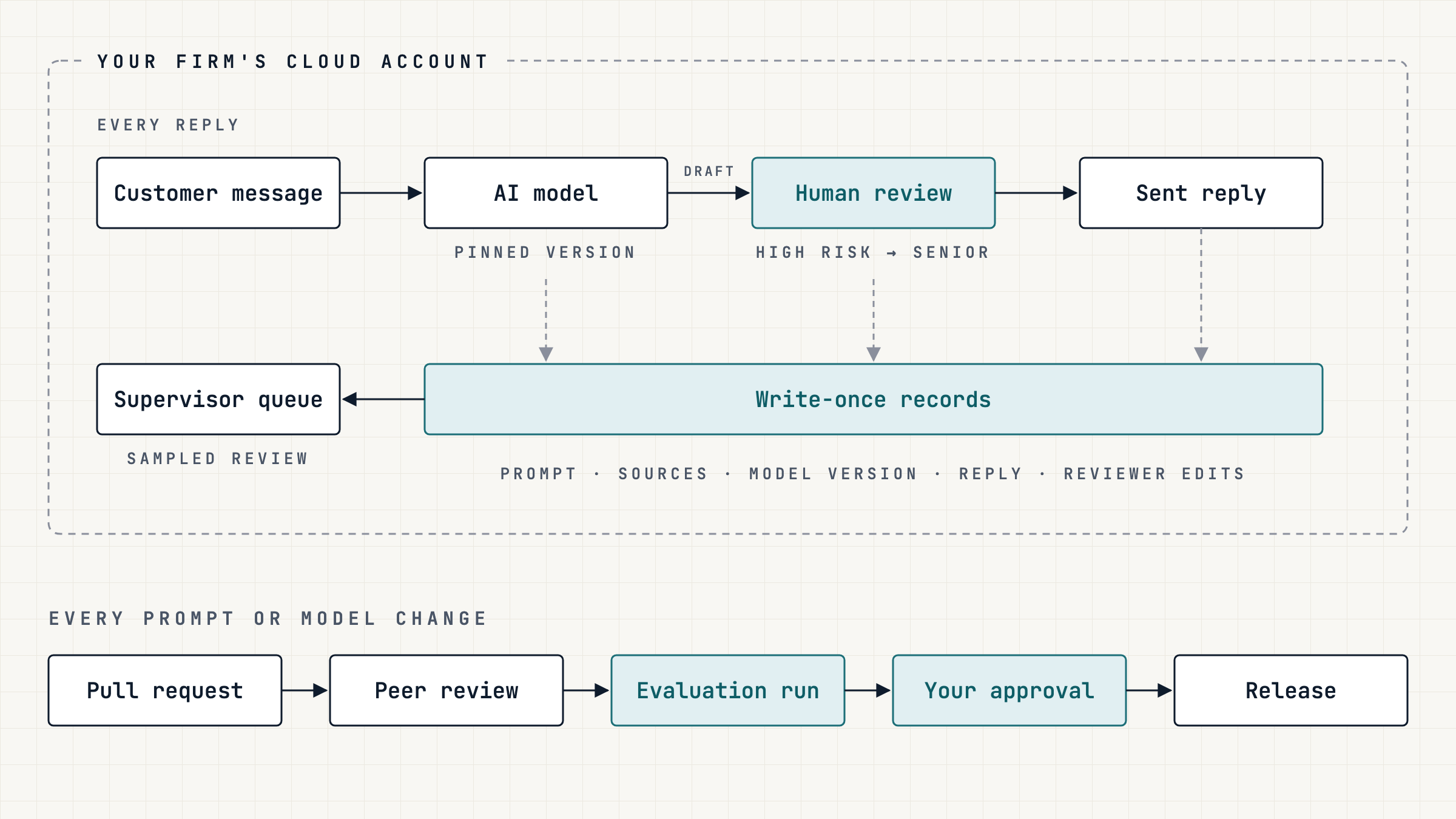
- the exact prompt sent to the model, including the template version and any instructions
- the documents or data retrieved to answer it
- the model identifier and version, and its settings
- the reply as generated
- who reviewed it, what they changed, and when it was sent
Where the reply is a communication with a customer, it is also a record. SEA Rule 17a-4 and FINRA Rule 4511 apply to it like any other correspondence. Store the records in write-once storage (on AWS, S3 Object Lock in compliance mode) with retention set to the firm's communications policy. Keep them inside the firm's own cloud account, and make them searchable by customer, employee and date.
This is what turns an examination request into a query. In our work for a brokerage with an AI assistant for customer messages, the firm answered a FINRA examination request with records and evaluation history instead of descriptions.
4. Put people where the risk is, and control every change
Human review that is built in, not promised
"A human reviews every output" is easy to write in a policy. It is only true if the system enforces it. For customer-facing tools:
- A draft can't be sent without a person's action, and the record shows who acted.
- High-risk topics (complaints, possible fraud, requests for investment advice) are detected and routed to senior staff.
- Supervisors get a sampling queue of sent replies, so review continues after launch, not just during the pilot.
Agents need more care. FINRA's 2026 report warns that agents may act "beyond the user's actual or intended scope and authority" and that their outcomes can be hard to trace. Give an agent only the permissions its task needs, log each action it takes, and require approval before anything that moves money, changes an account or contacts a customer.
A prompt change is a code change
A model's behavior can change without anyone touching the application code. Someone edits a prompt template, the vendor releases a new model version, or a setting changes. Each of these can make answers worse, and none shows up in a normal release process.
Treat them like code:
- Keep prompt templates, model versions and settings in version control.
- Require a pull request and a second reviewer for every change.
- Run an evaluation suite before the change can deploy: a few hundred realistic, masked examples with checks for accuracy, required disclosures, prohibited statements and tone. A change that lowers the scores is blocked.
- Pin model versions, so a provider's update is a change you test and approve, not one that happens to you.
This is where the evidence pays off. In the brokerage engagement above, the evaluation suite blocked two prompt changes that would have dropped a required disclosure, before either reached a customer.
5. When the AI talks to customers
Customer-facing output carries the most rules, so it needs the most controls.
- Content standards. Rule 2210(d) requires communications to be fair and balanced, with no false, exaggerated, promissory or misleading claims. Test for these in the evaluation suite, not only in reviews after the fact.
- The right review for the category. A chatbot reply to one customer is usually correspondence; the same text shown to many retail investors may be a retail communication, with different approval and filing rules. Decide which category each tool produces, and design the review path to match.
- Recommendations. FINRA's FAQ notes that if a broker-dealer uses AI to recommend a securities transaction, Regulation Best Interest applies. Keep AI tools out of recommendations unless the firm is ready to show how that obligation is met.
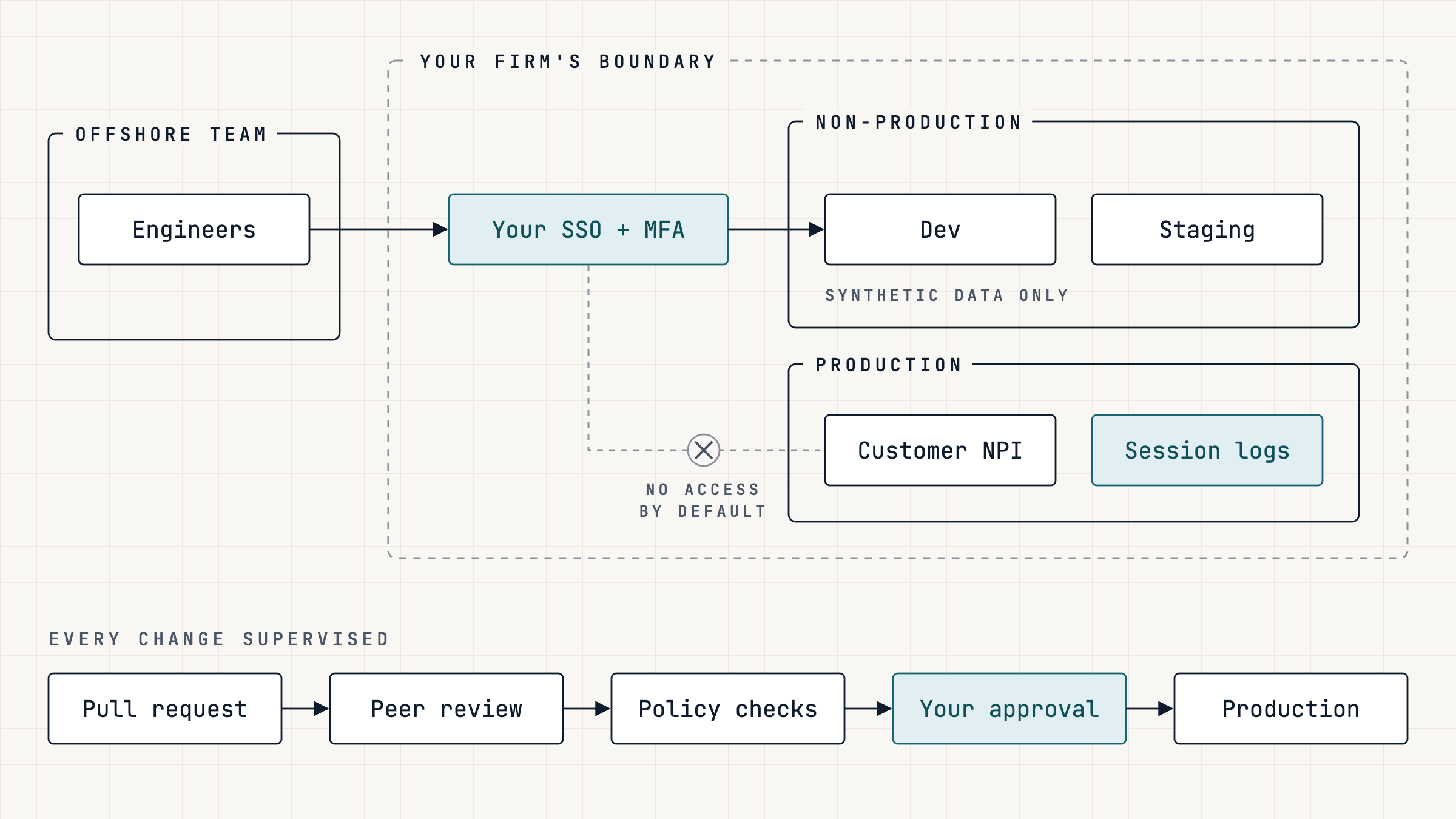
- Customer data. Keep prompts and data inside the firm's cloud boundary, use private endpoints, and confirm the provider doesn't train on your data. Our article on offshore engineering under Notice 21-29 covers the same boundary for vendors.
Investment advisers have no FINRA rule here, but the reasoning carries over. The SEC expects an adviser's compliance program to cover the tools it uses, and an examiner will ask the same questions about records, review and change control.
Checklist: can you show you supervise your AI?
- Is there a current list of every AI use at the firm, including vendor features, each with a named owner?
- For any reply a customer received, can you produce the prompt, sources, model version, reviewer and edits within a day?
- Are those records in write-once storage, inside your own cloud account, kept as long as your communications policy requires?
- Can a draft reach a customer without a person's action?
- Are complaints, fraud signals and requests for advice routed to senior staff?
- Does every prompt or model change go through review and an evaluation run before release?
- Are model versions pinned, so a provider's update is tested first?
- Can AI agents act only within the permissions their task needs, with each action logged?
- Do written supervisory procedures describe all of this, and does the system actually match them?
Supervision you can show
FINRA hasn't asked firms to stop using AI, or to wait for new rules. It has asked them to supervise AI the way they supervise everything else. For an AI tool, that comes down to records, review and change control, and those have to be built into the system from the start.
See how we made an AI feature audit-ready for a brokerage, read how we work with broker-dealers, or talk to an engineer about the AI tools your firm already runs.
This article describes what systems can do and what FINRA and the SEC have published. It isn't legal or compliance advice; your CCO and counsel decide what applies to your firm.
Written for